FCC bars conversions of land
July 2026
Reading Time: 5 Min
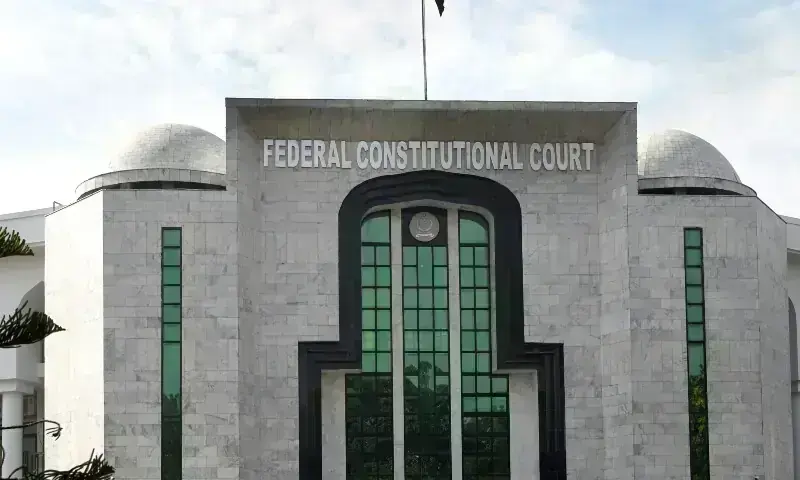
The Federal Constitutional Court (FCC), the highest judicial authority in the land, has made an important ruling barring the conversion of public land. In its judgement in response to a petition against a Peshawar High Court (PHC) ruling on conversion of industrial land into a housing scheme, the FCC ruled that land acquired for a specific purpose cannot be converted into a residential scheme later on.
The ruling was made on a petition made by M/s Adil International (Pvt) Ltd, which was made against a PHC judgement on the case issued on Sept. 11, 2024. It was on a case regarding a parcel of land in Mohal Amangarh, Nowshera Khurd, tehsil Nowshera in Khyber Pakhtunkhwa (KP).
This land was acquired in 1954 for industrial purposes by the government under the Land Acquisition Act, 1894. The intent was to establish Paper/Board Mills there. The total land area is 1020 kanals, 19 marlas.
In 2000, the assets of the owner of this land parcel back then, Adamjee Paper and Board Mills were auctioned off by the court to Adil International for Rs. 220 million. Adil International acquired the necessary approvals and then dismantled the factory structure on the land as it had become unusable. It then sought No Objection Certificates (NOC)s to convert this land into a residential housing scheme. This was eventually granted which led to Adil International developing residential plots and selling them on the land.
However, later on, government authorities began to refuse registering land deeds for the society and prevented transfers. Adil International sought legal assistance and presented the case to PHC which rejected its petition. Adil International then took the case to FCC which made the ruling barring the conversion of public land.
Adil International is not alone in converting land acquired for public purposes into residential schemes. This trend has been followed by many entities in Punjab, Sindh and Khyber Pakhtunkhwa and which will be affected by this judgement.
Analysis:
From an economic perspective, the ruling limits private capture of land-value gains created through rezoning. Residential land is often substantially more valuable than industrial land, particularly near expanding urban areas. Where land was originally acquired through state authority for a public or industrial purpose, allowing a private buyer to retain the full increase in value from residential conversion could create a large windfall unrelated to productive investment.
The judgment also reinforces an important real-estate principle: ownership does not automatically provide an unrestricted right to redevelop land. A property’s value depends not only on title, but also on zoning, acquisition conditions, planning approvals and public-purpose restrictions. Developers purchasing former industrial or government-linked properties will now need to examine the original basis of acquisition, rather than relying only on current approvals or NOCs.
In the short term, the decision may reduce the market value of former industrial sites whose prices were based on expectations of future housing development. It may also increase legal and financing risks for projects involving public, institutional or industrial land. Banks and investors are likely to demand stronger due diligence before financing such developments.
The ruling also raises concerns for buyers who purchased plots in good faith. In this case, plots had reportedly already been developed and sold before authorities refused to register transfers. Policymakers should therefore distinguish between developers, officials who issued questionable approvals and individual buyers who relied on government documentation. Ordinary purchasers should not bear the full cost of regulatory failure.
The case also highlights weaknesses in land administration. If one government authority issues approvals while another later blocks registration, both investors and households face serious financial losses. Greater coordination is needed among development authorities, land registries, local governments and provincial departments.
Overall, the ruling is economically and legally defensible because it protects the integrity of compulsory acquisition and prevents speculative conversion of land obtained for public purposes. However, an absolute restriction could also leave obsolete industrial land unused. Pakistan therefore needs a transparent framework through which land can be legally repurposed when its original use is no longer viable.
Such a process should require updated valuation, clear government authorization, infrastructure assessment and recovery of part of the land-value increase for the public. The Court has established an important legal boundary; the policy challenge is to apply it without harming good-faith buyers or preventing legitimate urban redevelopment.
The ruling was made on a petition made by M/s Adil International (Pvt) Ltd, which was made against a PHC judgement on the case issued on Sept. 11, 2024. It was on a case regarding a parcel of land in Mohal Amangarh, Nowshera Khurd, tehsil Nowshera in Khyber Pakhtunkhwa (KP).
This land was acquired in 1954 for industrial purposes by the government under the Land Acquisition Act, 1894. The intent was to establish Paper/Board Mills there. The total land area is 1020 kanals, 19 marlas.
In 2000, the assets of the owner of this land parcel back then, Adamjee Paper and Board Mills were auctioned off by the court to Adil International for Rs. 220 million. Adil International acquired the necessary approvals and then dismantled the factory structure on the land as it had become unusable. It then sought No Objection Certificates (NOC)s to convert this land into a residential housing scheme. This was eventually granted which led to Adil International developing residential plots and selling them on the land.
However, later on, government authorities began to refuse registering land deeds for the society and prevented transfers. Adil International sought legal assistance and presented the case to PHC which rejected its petition. Adil International then took the case to FCC which made the ruling barring the conversion of public land.
Adil International is not alone in converting land acquired for public purposes into residential schemes. This trend has been followed by many entities in Punjab, Sindh and Khyber Pakhtunkhwa and which will be affected by this judgement.
Analysis:
From an economic perspective, the ruling limits private capture of land-value gains created through rezoning. Residential land is often substantially more valuable than industrial land, particularly near expanding urban areas. Where land was originally acquired through state authority for a public or industrial purpose, allowing a private buyer to retain the full increase in value from residential conversion could create a large windfall unrelated to productive investment.
The judgment also reinforces an important real-estate principle: ownership does not automatically provide an unrestricted right to redevelop land. A property’s value depends not only on title, but also on zoning, acquisition conditions, planning approvals and public-purpose restrictions. Developers purchasing former industrial or government-linked properties will now need to examine the original basis of acquisition, rather than relying only on current approvals or NOCs.
In the short term, the decision may reduce the market value of former industrial sites whose prices were based on expectations of future housing development. It may also increase legal and financing risks for projects involving public, institutional or industrial land. Banks and investors are likely to demand stronger due diligence before financing such developments.
The ruling also raises concerns for buyers who purchased plots in good faith. In this case, plots had reportedly already been developed and sold before authorities refused to register transfers. Policymakers should therefore distinguish between developers, officials who issued questionable approvals and individual buyers who relied on government documentation. Ordinary purchasers should not bear the full cost of regulatory failure.
The case also highlights weaknesses in land administration. If one government authority issues approvals while another later blocks registration, both investors and households face serious financial losses. Greater coordination is needed among development authorities, land registries, local governments and provincial departments.
Overall, the ruling is economically and legally defensible because it protects the integrity of compulsory acquisition and prevents speculative conversion of land obtained for public purposes. However, an absolute restriction could also leave obsolete industrial land unused. Pakistan therefore needs a transparent framework through which land can be legally repurposed when its original use is no longer viable.
Such a process should require updated valuation, clear government authorization, infrastructure assessment and recovery of part of the land-value increase for the public. The Court has established an important legal boundary; the policy challenge is to apply it without harming good-faith buyers or preventing legitimate urban redevelopment.
More Policy and Regulations

Is Pakistan's Real Estate Market Reviving?
FBR’s Revenue Shortfall vs. The Property Paradox The Federal Board of Revenue (FBR) published its…

SBP New Regulations for Housing Finance
The State Bank of Pakistan (SBP) has made amendments to its Prudential Regulations for Housing…

Relief for Real Estate? Finance Act of 2027
The Finance Act of 2027 has been passed and it contains several provisions which are…
Punjab Government to overhaul Lahore’s property ownership system
The Punjab Government has launched a major initiative to replace all legal proofs of ownership…
